

Contact Information
-
MAILING : P.O. Box 8, Los Olivos, CA 93441
My headlamp shines a dim spotlight onto the center of a small circle of girls. We sit around a Whisperlite Backpacking stove, watching like hungry hawks as I place a thinly-sliced-and-perfectly-spiced potato into the pot of hot oil.
Almost every weekend, five to ten friends and I spend our Friday night hiking a few miles from our dorms on a student-led camping trip, a simple yet ample way to enjoy the rolling grasslands that whisper in the wind and the ancient-burly oaks that have borne witness to generations of students just like me.
For the last 2 years, this has been my idea of a weekend night well spent, an overnight representation of the sweat on our backs as we sowed seeds and weeded the ground to grow that now-crispy potato on our school’s farm. Of the 16-hour Wilderness First-Aid course and days spent learning risk management and outdoor leadership in order to gain the trust from faculty to take my peers on overnight camping trips. Of the senior who two years ago thought to invite a timid freshman (me) to join them for a night among the crickets, cozy in sleeping bags while we shared stories and laughter.
Many high schoolers spend their Friday nights at ragers or strip malls. I prefer the shooting stars over my head, the crackling warmth of a campfire, and the satisfying crunch of a freshly fried potato.
– Amelie Grant, Midland ‘27
In 1932, amid the worst economic crisis in American history, Paul Squibb wrote a letter to friends announcing his intent to start a school.
There would be no kitchen staff. No janitors. No luxuries. Just students, teachers, and a stretch of wild California land. Squibb wasn’t looking to start a school in the usual sense. He was building a place to teach the values of self-reliance, community, and simplicity. He called it Midland. The first seven students lived in the Main House with the faculty. They chopped wood for heat, hauled water by hand, constructed board and batten classrooms and cabins, and built timber desks to sit solid on a gravel floor.
The idea of the place was not to escape the real world but to learn how to live within it, with purpose, discipline, and care. “Our school will be operated on the self-help plan,” he wrote. “Which means every boy will be obliged in part to work his way through.”
Nearly a century later, the founding beliefs still hold: that young people are not only capable of meaningful work, but that such work is essential to their growth. That character, not comfort, is the foundation of a life well lived. Born in the wake of the Great Depression, Midland’s financial assistance philosophy also remains firmly in place, set in the principle that no student should be turned away based on the ability to pay.
A Midland education began with a student, a teacher, and an idea. Today, the school carries that essential spirit, developing academic excellence alongside life skills that matter: curiosity, communication, critical thinking, and the confidence to lead.
Midland sits on 2,860 acres, rising to the edge of the Los Padres National Forest. Oak woodland, chaparral, serpentine ridges, and sagebrush adorn this slice of California’s Santa Ynez Valley, an ancestral Chumash landscape. Honoring people who stewarded this land long before Midland is foundational to students’ emerging connection to place. Whether they are studying the geology and ecology of the land itself, the Chumash ethnobotanical uses of local plants, discussing cultural amalgamation and “double consciousness” through the lens of Leslie Marmon Silko’s novel, “Ceremony,” or unpacking the history of European settlers and tribal sovereignty in U.S. History, Midland students dig into a myriad of histories and cultures with depth and nuance.
The school’s campus has three main areas: student cabins are in Upper Yard and Lower Yard, while Middle Yard is the academic and communal center. Students share a cabin with a roommate and the occasional pet. Faculty homes are interspersed throughout.
Eight classrooms, two barns, ten acres of farm, and twenty-three cabins–I can see all of these buildings laid out like dollhouses as I sit perched on a cliff edge five hundred feet above Middle Yard, where most of the student body sits in classes.
— Jay Liu, Midland ‘27
Place shapes Midland’s pedagogy. Students learn to see this landscape as a layered story, where new ideas and experiences are added to what came before. Science students track the watershed to measure changes after rain. In History, they apply knowledge of the Columbian exchange as they examine the historical roots of the cultivated and native plants found on the property. Art explorations draw from the surroundings, crafting insects from natural materials and honing surfboards from salvaged wood. One day each year, students wake to the news that classes have been cancelled. Everyone, as a group, hikes together to the 3,685’ peak of Owotoponus, or Grass Mountain, overlooking the campus all the way to the Pacific Ocean.
The lights are off—it’s well past curfew. Curled in a ball around my roommate’s snoring white Labrador Retriever, I stuff my face into my pillow as my body shakes with laughter…Whispers of teenage gossip, a homework assignment breakdown, an idea brain-dump session, or a late-night deep dive into the intricacies of growing up in such a complex world.
As I drift into sleep, I know that whatever happens, I will always fit here: letting my body rest after a day of learning, challenging myself, and working alongside my peers to make this place a little better than before, whispering ‘goodnight, I love you’ to the girl who lays across the room from me, a stranger-turned-sister from these two years living together at Midland.
— Amelie Grant, Midland ‘27
Midland is intentionally scaled: eighty-some students, thirtyish faculty and staff. All students live on campus. Faculty do, too. What results is not just familiarity, but shared lives—meals, conversation, collaboration, and interconnected learning.
Midland days begin with work. Students clean classrooms, tend horses, harvest vegetables, or split kindling. Breakfast is in Stillman Hall, followed by classes and a student-grown midday meal. Twice-daily, Assembly includes announcements, celebration, or recruitment for an upcoming event or need.
Afternoon activities shift with the season: mountain biking, outdoor leadership, horsemanship, trailwork, cross-country, soccer, or time on the farm. Family-style dinner, students settle into study hall, then a final social ‘tea time’ for a snack before bed. Evenings end with Prefect check-ins and final faculty rounds.
Tuesday and Thursday afternoons are unstructured free time known as Half Holidays. Weekends include learning through real work experience, student-led overnight trips, time for study, and rest. After a Sunday morning sleep-in, students join faculty for the week’s formal Work Period to maintain and care for their campus home.
Before coming to Midland, all of my schools looked the same: hallways, lockers, paved playgrounds, and few trees. Midland is the complete opposite. We live in cabins on a ranch surrounded by open sky, oak trees, and mountains. I wake up to the sound of birds or sometimes chickens, and I walk past horses throughout my day.
There’s so much nature here, it’s wild. We hike, backpack, ride horses, and spend weekends doing “hardluck hikes” that push us out of our comfort zones. It’s tough, but also kind of amazing. You end up learning a lot about yourself out there. Midland challenges you in the best way.
— Pyp Pratt, Midland ‘27
The academic year unfolds across a series of six-week terms, each followed by a break without assigned homework; focused work during term time and full rest in between.
Back in the 1940s, when Squibb noticed students returned from fall break sick and depleted, he began inviting parents, grandparents, siblings, alumni, and friends to campus for Thanksgiving. Each year, around 500 people gather at Midland for a bountiful community meal.
MIDterms, held twice each year, are week-long, fully immersive experiential learning opportunities for hands-on student projects and ideas that don’t fit neatly into the regular schedule. Everything from groups exploring food security at urban farms in Los Angeles to researching and writing a play that explored Midland’s past, present, and future.
Monday and Thursday evenings include an all-school gathering in the chapel, a secular space for talks exploring the community experience—personal stories, hard-won insight, forward-dreaming, and scholarship.
Chapel, an ancient wooden building as old as the school—approaching a hundred years of use. Originally a milking parlor, it is the most reverent place on campus. The walls are covered by ninety-three wooden boards, each containing the hand-painted names of every student who has ever completed a year at Midland.
Some days, the silence is only broken by someone delivering life lessons a local from their hometown taught them. On others, stifled tears as a teary-eyed faculty grieves a lost family member, or shares the wisdom their passed grandmother granted them. And some days the walls ring with laughter, as someone shares the funniest stories they have kept secret since freshman year. But what remains constant is the insight imparted and the community created.
— Jay Liu, Midland ‘27
Midland’s academic program is grounded in real-world application. Students meet University of California A–G requirements. Graduates regularly move on to exceptional colleges and universities, as well as extraordinary programs in horsemanship, outdoor leadership, and agriculture.
Students are guided in seven core competencies: critical thinking and analysis, craftsmanship, problem solving, literacy and voice, being of use, connection to place and environment, and commitment to diversity, equity, inclusion, and justice. Students receive direct feedback. They revise. They retake. They grow. Skills are practiced everywhere: on paper, in dialogue, in the lab, at the woodpile, on horseback, in the strawberry rows, and on the trail.
Technology is a tool here, not the center of campus life. Students hand over their phones at the beginning of each term. The Internet and AI are here as academic resources; learning and community do not rely on them. In the absence of constant distraction, conversations stretch, friendships deepen, mountain bikes find trails, music emerges, and time is no longer split into tabs.
Students progress to take ownership of their education. Each senior completes and presents a self-directed capstone thesis or project: independent studies rooted in questions and problems they care about. They conduct comparative studies of U.S. History curricula across America to understand political polarization; they build mountain biking trails and surfcrafts for their fellow Midlanders; and they apply coding skills to create a video game based on their school.
With mastery comes opportunity for leadership—through teaching and mentoring younger students and taking on real responsibility within the community. Students lead job crews, manage gear rooms, guide outdoor trips, mediate peer dynamics, and run assemblies.
Students also organize groups and events that share their cultures, histories, and traditions with the broader community, expanding understanding through lived experience rather than abstraction.
At Midland, the work of supporting and considering diversity, equity, inclusion and justice isn’t siloed into a single class or a handful of dates on the calendar. It is alive in the fabric of each day, from equitable grading policies to monthly film festivals and workshops and a restorative accountability system, grounded in clear expectations and shared responsibility. Courses are designed to present students with both “mirrors” of their own experience and “windows” into perspectives and identities distinct from their own.
“I wander through Stillman – our dining hall transformed into a gallery for our Diversity, Equity, Inclusion and Justice Summit. Everyone is here exploring so many artifacts of learning. I see student’s takeaways from workshops about color symbolism in traditional Chinese culture, Black resilience and resistance through hip hop, ableism and activism in the modern age, and the disproportionate impacts of climate change on marginalized communities. I stand in awe of these young people who have opted to spend their free time over lunches and afternoons over the past six weeks planning workshops and film discussions about topics close to their identities – and their peers who engage with genuine curiosity and respect. I think of our Asian American Alliance working closely with the extraordinary staff who make Midland’s food to cook an elaborate multi-course meal for one hundred of us to celebrate Lunar New Year. And “Queercus” (LGBTQIA+ group) putting on a Drag Show that brought us together in joyful celebration. I remember LatinX bringing Dia de los Muertos to life: an incredible ofrenda of farm-grown marigolds, papel picado banners and painted calaveras to honor our loved ones who have crossed over. Ours is a community small enough for everyone to be known, to have a real voice and impact, and where belonging is a co-creation that makes the whole greater than the sum of its parts.”
– Ellie Moore, Associate Head of School
Students rotate through daily jobs that keep the campus running. With experience, they take on more responsibility—leading crews, mentoring peers, managing gear rooms, and serving as prefects. The Student Council works with faculty and the Head of School to adjudicate major rule infractions. These roles demand initiative, communication, and leadership skills that many young people don’t encounter until college or beyond. Students are held both capable of and accountable for delivering on their responsibilities. Through every facet of autonomy and interdependence, students are supported to learn as their best selves.
At Midland, helping out is just part of life. Students clean bathrooms, wash dishes, and muck out stalls. Jobs I’d never done before. I didn’t even do my laundry at home. Our prefects check our work and help us stay on track. They’re not harsh, but they do expect us to take our jobs seriously.
— Pyp Pratt, Midland ‘27
Accountability to self and to community is foundational to a Midland education. A job left undone or a choice to break school rules often has an impact on others. Consequences for those actions are considered opportunities for both repair and learning. Midland’s ‘lap system’ is simple and consistent, requiring students to spend a designated portion of their free time on community work in restoration of their mistake.
Some of the most remarkable moments at Midland start with a shovel, a pack, a saddle, a saw, or a seed.
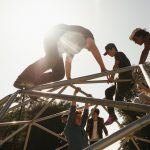
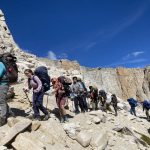
Outdoor Leadership takes students into the extended campus. Trips range from nearby swimming holes to high-country mountaineering routes. Others cross into the Los Padres National Forest for days (and occasionally weeks) at a time. Students lead trips, cook meals, navigate trails, and manage safety. By senior year, many are teaching these skills, and spearheading student-only overnights on the property, called Hardlucks, one of the most beloved Midland traditions.
Before becoming a Midlander, I had never touched a horse, let alone ridden one. Midland attracted me through the prospect of backpacking and hiking around the large property with hills and cliffs–I never even pictured riding on horseback. But after a year here, I knew I had to branch out and sample everything the school had to offer.
— Jay Liu, Midland ‘27
Horses give students a chance to practice husbandry and self-awareness through riding, training, and tending to their four-legged partners. Riders learn natural horsemanship, starting with groundwork and trail basics. Often riders expand their skills into cattle work, gaining exposure to real ranch horsemanship and stock sense. Midland’s twenty-horse herd lives on campus year-round and is cared for every day by students, creating deep familiarity and genuine partnership. With more than twenty-five miles of riding trails winding through oak groves, a large arena, and a fully equipped tack room, students gain firsthand experience not just in riding, but in stewardship, communication, and patience.
The food students grow at Midland makes up more than half what the community eats: pickled beets in the salad bar, roasted squash with campus-raised pork, strawberries turned into ice cream by student hands. The school’s 10-acre organic farm and garden brings routine – digging, weeding, harvesting – and also delight. Students wash carrots, haul compost, and learn when a melon is ready by how it smells. They slip out to the rows between classes for ripe strawberries. The farm teaches students to notice, contribute, and take pride in feeding people.
The people here are just as unique as the landscape. Everyone comes from different backgrounds. Some students wear flannel shirts and boots; others wear graphic tees and beanies. There’s freedom to be yourself, but that comes with responsibility.
— Pyp Pratt Midland ‘27
Trail building gives students a lasting way to shape the place. They cut switchbacks, lay drainage, and reroute erosion-prone paths. Mountain biking, the most recent addition to Midland’s experiential curriculum, emerged from this work. Students ride the trails they’ve built, tasting the fast and dusty fruit of their own labor. Alumni return to campus years and even decades later to hike to the trails they hand-crafted with friends and faculty. Parts of the extended campus trail system are available to the public through a conservation agreement with the county.
“Today we are seeing the dreams of inspired poets merging with the findings of careful scientists. The dreamer and the doer are showing the thinker new vistas of life on earth. New glories are coming to light for thoughtful minds.” – Paul Squibb, founder, 1932
The people who choose Midland are curious thinkers and active learners, often with strong academic records, looking for a school that feels more connected, more hands-on, more whole. Students come from cities, rural towns, far away countries, public schools, and homeschooling. The admissions team says they can see immediately when a visiting student knows Midland is right where they want to be.
Midlanders care about how things are made, where things come from, and whom they affect. They seek academic challenge and dialogue within disagreement. They ask big questions and are willing to live inside them. They are looking for belonging, and they are willing to help build it.
Faculty arrive with similar instincts. They come to teach what matters and to live in rhythm with the values they hold. Many hold advanced degrees in their disciplines. All are deeply invested in the practice of teaching through lived experience and find purpose in helping students develop core skills and competencies. Midland faculty advise, mentor, lead trips, and are fully embedded in school life.
English class on Thursday morning carries the joyful echo of surfing together on Wednesday afternoon. At dinner, we eat food that we grew and harvested here with our own hands. Learning, exploring, growing, and living together strengthens our relationships, and becomes the fabric of this place. Here, time feels thicker, slower, more nutritious and complete.
–John Babbott, Humanities Faculty
Midland graduates leave for competitive colleges and careers, but most importantly prepared for lives with purpose and direction. Graduates carry with them other things, too: a bias toward usefulness; an instinct to contribute before they critique; and an unshakable understanding of what it means to belong to place, to community, and to themselves.
I can trace so many threads back to those four years in the Santa Ynez Valley. I learned the contours of Midland’s landscape and the names of native species. I learned to troubleshoot a solar panel malfunction, to manage a team of peers while running the dish crew, and to stay calm when a horse spooked on the trail. I discovered how to advocate for myself professionally and lead others through difficult times.
The writing and analytical abilities I developed in Midland’s English and History classes carried me through a degree in English Literature from Whitman College and a master’s degree in Publishing & Writing from Emerson College.
— Emma Struebing, Midland ‘16
Students find at Midland a path to discovering and building the person they want to be: the artist, the mountaineer, the designer, the engineer. Midland graduates leave not just with acquired knowledge, but with a stronger sense of who they are, what it means to be of use, and to belong.
I don’t often chop wood anymore. In my adventures after Midland—from Williams College in Massachusetts to a Masters in Physics at the University of British Columbia to managing the Climbers Ranch in Grand Teton—I’ve realized that wood chopping was never really the point.
Each of these experiences underscored for me the key values that Midland teaches at the woodpile: find what you need, work in service of those around you, better yourself and the place you are in. Those values still drive me.
— Duncan McCarthy ‘17
. . .
Submission Completed By: Shona McCarthy, Andrew McCarthy ‘85, Hannah Nelson, Cierra Rickman, Ellie Moore, Dan Susman
Want to read the whole book?
Read more from our Real Talk series