


Contact Information
-
MAILING : P.O. Box 8, Los Olivos, CA 93441
A conversation with Lauren Pearson, Horse Program Director & Educator
Each morning, as Lauren Pearson walks toward the Kit Rich Dreyfuss Barn, she is met first not by a schedule or a task list, but by a place that asks for presence.
The quiet.
The shifting light across the hills and Grass Mountain.
The horses lifting their heads as she approaches.
From her home near the edge of campus, Lauren sees the rhythms of the land unfold daily — quail scattering across the pastures, coyotes passing through after rain, the occasional egret lingering longer than expected. For her, this landscape is not a backdrop to the work; it is part of the work itself.
“This place has its own life force,” Lauren says. “It invites reflection. You slow down here. You notice more. And that changes how you show up — for the horses, and for the students.”
Lauren joined Midland School this past school year as Horse Program Director & Educator, bringing decades of experience teaching and working with horses in educational settings. What drew her to Midland was not simply the opportunity to lead a program, but the alignment she felt with the school’s deeper purpose.
“The values that matter here — self-reliance, responsibility, care — are the same qualities horses naturally draw out of people,” she explains. “That makes this place uniquely suited for this kind of learning.”
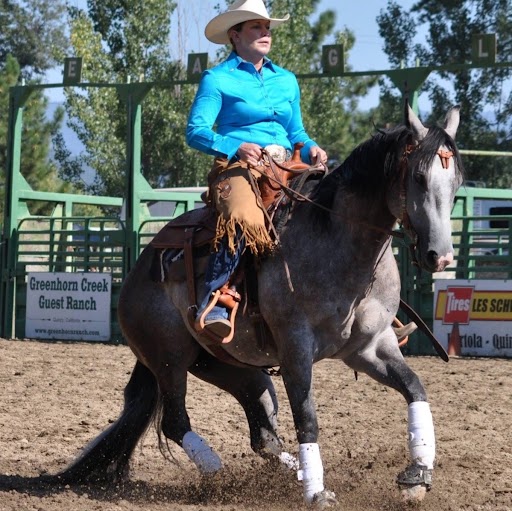
Lauren, pictured riding in a ranch versatility show in 2016
At Midland, horses are not simply part of the curriculum. They are teachers.
“Horses mirror us,” Lauren says. “Whatever we bring into the space — confidence, hesitation, frustration — they reflect it back. They don’t judge it, but they respond to it honestly.”
That honesty is what makes the learning so powerful.
For many students, the barn is unfamiliar territory. The animals are large. The environment is demanding. The responsibility is real.
“When students first arrive, especially those with no prior experience, intimidation is common,” Lauren explains. “But through small, intentional moments of success, something begins to shift.”
Confidence grows. Awareness deepens. Students begin to trust themselves.
“One student told me recently, ‘This is the first time in a long time I’ve felt successful at something,’” Lauren recalls. “That kind of moment doesn’t stay contained to the barn. It carries into everything else.”
Those moments reflect the qualities at the heart of Midland’s Portrait of a Graduate: resilience, self-awareness, responsibility, and the ability to engage thoughtfully with both people and place.
One of the most enduring lessons students learn through the horse program is the difference between control and care.
“There are times when students need to be firm — especially for safety,” Lauren says. “But leadership isn’t about domination. It’s about awareness and responsiveness.”
She describes guiding a student through a challenging interaction with a young horse — raising energy when necessary, then softening the moment the horse responds.
“Leadership is knowing when to step forward,” she explains, “and knowing when to ease back.”
This balance — between decisiveness and empathy — is one students practice repeatedly in the barn, and one that serves them well far beyond it.
The barn is also a place where students encounter uncertainty — and learn how to move through it.
Plans change. Horses lose shoes. Weather intervenes. Fear surfaces. Sometimes students fall, get shaken, or have to rebuild confidence after a difficult moment.
“These experiences matter,” Lauren says. “They teach students how to pause, assess, and pivot — skills that are essential in leadership and in life.”
She smiles as she adds, “One thing horses are very consistent about is being unpredictable.”
Over time, students learn that discomfort is not failure — it is often the threshold of growth.
Lauren speaks of stewardship not as an abstract concept, but as a daily responsibility.
“My role is to hold this program in trust,” she says. “For the students. For the horses. And for the land.”
That responsibility shows up in countless decisions — from herd dynamics to care practices to infrastructure investments — all made with the long-term health of the program in mind.
“When the horses are settled and cared for well, students feel it,” Lauren explains. “The space becomes safer, calmer, more open.”
Students have noticed.
“More than one has said to me recently, ‘The horses feel really happy,’” she says. “That meant a great deal to me.”
The barn is intentionally a welcoming space — open to students who arrive confident, cautious, or simply curious.
“This is a place to learn,” Lauren says. “Not a place to prove something.”
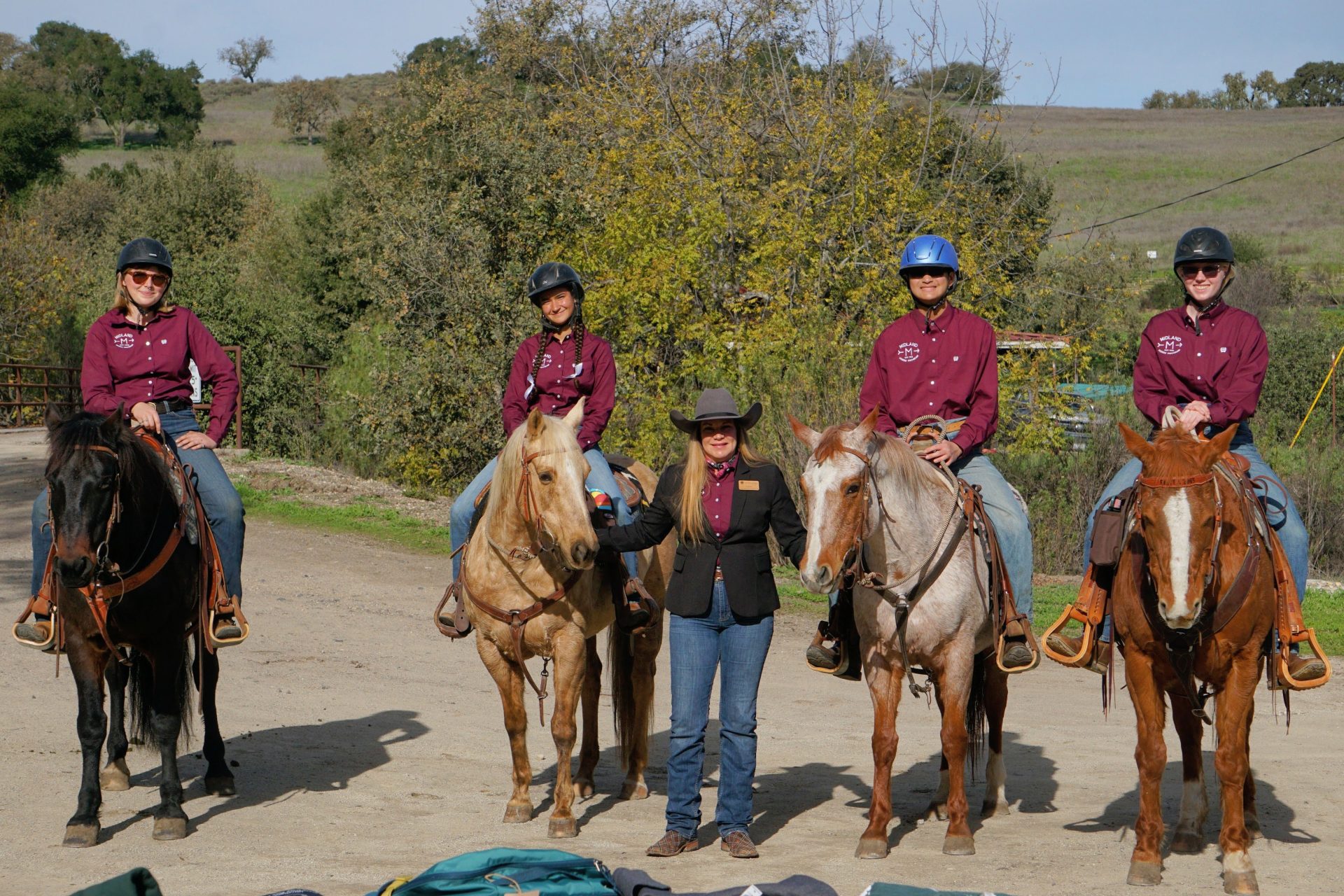
Lauren (center), pictured with horsemanship students who helped direct traffic and parking for Thanksgiving 2025
When asked about her vision for the horse program, Lauren does not speak in terms of accolades or benchmarks.
“I hope the connection continues to deepen,” she says. “Between students and horses. Between students and the land.”
She envisions expanded experiential opportunities over time — trail work, horse camping, packing clinics, collaborative partner school programs — always grounded in sustainability and care.
“It’s a journey,” she says. “You build it thoughtfully. You don’t rush it.”
As students leave Midland, Lauren hopes they carry more than technical skills.
“I want them to know they can do hard things,” she says. “That how they show up matters. That leadership is about awareness and responsibility.”
She pauses before adding:
“The more you put into it, the more you get out of it. That’s true with horses — and that’s life.”
In the daily rhythms of care, shared responsibility, and quiet moments of breakthrough, the horse program reflects something essential about Midland itself: learning that is lived, leadership that is practiced, and growth that unfolds through patience, presence, and trust.
Written by Jasmine Fullman, Admissions and Advancement Associate
Continue exploring the Midland experience