
Contact Information
-
MAILING : P.O. Box 8, Los Olivos, CA 93441
Sascha reflects on skateboarding, sculpture, creative risk, and building spaces people can actually use.
Spring 2026
I built a giant fingerboard skate park out of concrete and metal. It’s about the size of a folding table and fully functional. I built the structures out of foam core first, then layered concrete over them, added rails, rocks, and transitions, and basically treated it like a real skate park on a miniature scale.
It’s definitely one of the biggest things I’ve ever built.
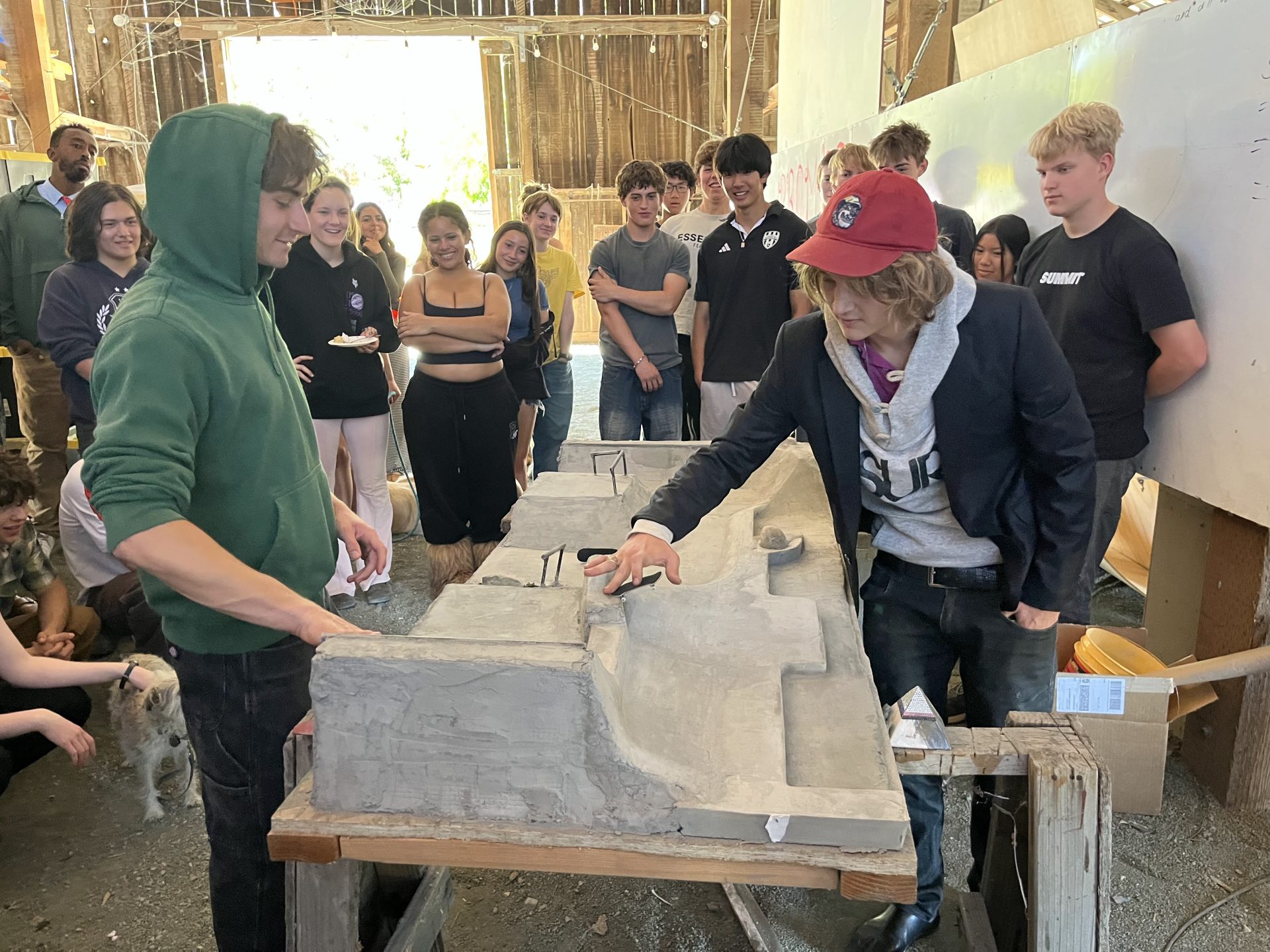
Sasha (right) demonstrates how to use his skate park
I’ve always been that way. Even as a kid, I was constantly building giant cardboard sharks, fingerboard parks, weird structures, all kinds of stuff in my room. I draw too, but when I really wanted to make art, it almost always became three-dimensional. Building things just felt natural to me.
And then in fifth or sixth grade, my art teacher came over to my house with scrap metal and a welder and taught me how to weld. After that, sculpture and building became a huge part of how I expressed myself creatively.
It honestly became everything for me during that time. My friend Beckett and I would wake up at six in the morning before Zoom school and go skate together at the park before classes started. It gave structure to my days and made me feel less trapped during the pandemic.
But more than that, skating immediately felt artistic to me. It combines movement, creativity, fear, improvisation, expression, all of it. To me, skateboarding feels more like dance than a sport.
Everything in skating is a response to space. The trick you choose depends on the spot itself. A staircase changes what you do. A curb changes what you do. A rail changes what you do. So when you’re skating, you’re constantly responding to architecture and form and movement all at once. That’s why I think it’s such an art form. You’re interacting with sculpture and environment constantly.
I think people miss how emotional and creative it is. A lot of mainstream skateboarding now is competition-based and centered around scoring points or sponsorships or Olympic skating. But that’s never really been the heart of it to me.
The real heart of skating is expression. Style matters. Creativity matters. The feeling matters. When people who don’t skate watch it, they sometimes only see tricks. But when you actually skate, you understand how much thought and feeling and experimentation go into every decision.
Definitely both. The skate park I built is absolutely sculpture to me, but it’s also fully functional. I use it constantly. That combination is really important to me. I love making things that are visually interesting but also meant to be physically interacted with.
I love museums and visual art, but at some point I also want spaces that invite movement and play. I think public spaces can shape the way people feel and interact with each other. That’s why I’m interested in sculpture and maybe architecture or urban planning too.
There are places in Europe where there are little skate spaces built naturally into the city that don’t even look like skate parks at first. They just invite interaction. I think that kind of design is super cool.
Each material feels emotionally different. Clay feels calming and meditative. Concrete is more stressful because you have to move quickly before it sets. Metal feels harsher and more physical. Different materials make me think differently while I’m working.
At first I was honestly really disappointed. But I think what I learned was that I didn’t want that setback to kill my excitement about the project itself. I still wanted to build something connected to skating and space and creativity, even if the form changed.
And honestly, the pivot ended up being a blessing in disguise because it introduced me to concrete, which I now want to keep working with.
I think that is the creative process. I’m honestly not amazing at planning. But once I start making something, I get completely immersed in it.
There were so many moments during this project where I had to redo parts, rethink parts, or completely pivot because materials weren’t behaving the way I expected. But some of those changes actually made the skate park better.
That’s true in skating too. You try something. It fails. You adjust.
Definitely. A few days before the deadline I genuinely didn’t think I was going to finish it. I didn’t have enough concrete. I accidentally bought the wrong kind at one point and had to sift pebbles out of it with chicken wire.
It was chaos. But I think what surprised me most was finally building up the courage to actually start pouring the concrete. Once I started, it suddenly became real. And then eventually I looked at it and realized, “Oh wow… this actually became the thing I imagined.”
It feels like I’m thinking through my hands. When I’m building something, I stop overthinking everything else and become fully focused on the process in front of me. It’s almost meditative.
At Midland, this became a class. That’s the huge difference.
At another school, this probably would’ve just been some weird thing I tried to build alone after homework. Here, I had studio space, materials, time, teachers supporting it, and people genuinely encouraging me to pursue it seriously. That’s really rare.
Definitely. I feel like Midland encourages students to pursue things that actually matter to them personally instead of only focusing on assignments that feel disconnected from who they are.
That’s been true for me not just in art, but even in classes like Field Ecology and English. I’ve felt really encouraged here to follow curiosity and build things connected to my own interests.
Definitely. The skateboarding community has been one of the most consistent communities in my life. Most of my closest friendships came through skating.
So even though I built the park myself, I always imagined it as something people could gather around together, hang out with, try tricks on, film clips with, all of that.
It made me less afraid to try bigger things.
Before this, I think I sometimes got stuck in the idea phase because large projects felt intimidating. But now I feel much more confident actually attempting things even when I don’t fully know how they’re going to turn out.
And it also solidified for me that this is what I want to keep doing. I want to keep building things. I want to keep making art.
Try it anyway. You might have to adapt the idea or change parts of it, but that’s okay. I don’t think ambitious ideas are bad. I think they’re important. A lot of learning comes from not fully knowing what you’re doing yet.
Written by Jasmine Fullman, Admissions Associate