


Contact Information
-
MAILING : P.O. Box 8, Los Olivos, CA 93441
Z reflects on building a synthesizer from scratch, learning through failure, and why understanding technology matters.
Spring 2026
When Z began building a synthesizer from scratch for his senior project, he had almost no background in electronics. What he did have was curiosity.
A guitarist and music enthusiast, Z had spent years fascinated by the sounds created through pedals, modulation, distortion, delay, and electronic layering. Long before he understood the circuitry behind any of it, he found himself wanting to know what was actually happening underneath the surface of the music he loved.
“I’ve always asked too many questions,” he says, laughing. “If I don’t understand how something works, I feel this fundamental discomfort with the situation.” That instinct eventually led him deep into the world of analog synthesizers, waveforms, circuits, oscilloscopes, filters, and sound design. What began as a personal curiosity slowly evolved into a months-long process of experimentation, troubleshooting, research, failure, and hands-on engineering.
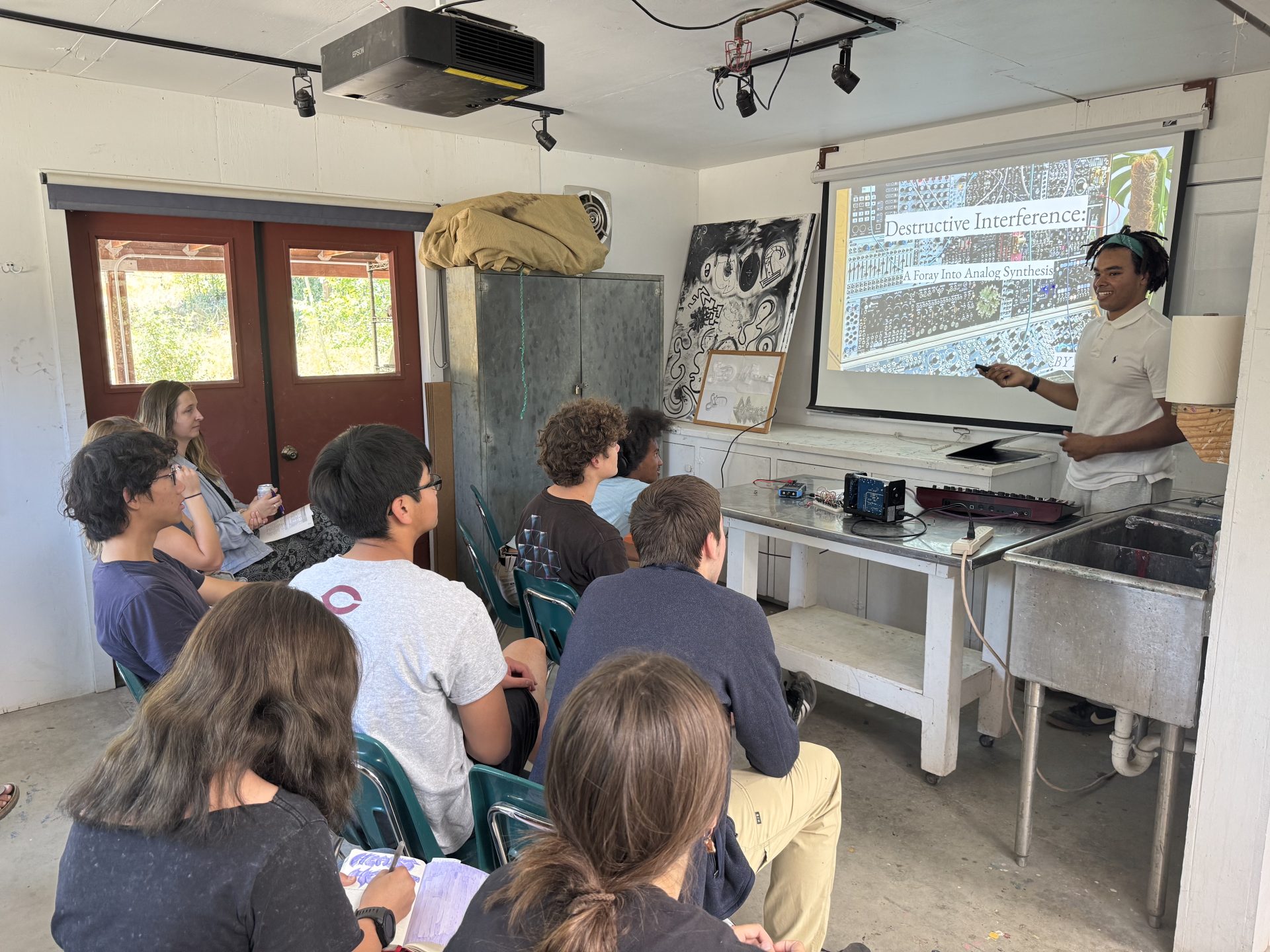
Z presenting his project during Senior Symposium
Basically, speakers turn voltage into sound. So what I was trying to do was create an electronic signal that resembled the timbre or texture I wanted to hear. A synthesizer is really just electronics creating texture and sound.
I think it started in eighth grade when I took apart my electric guitar because I wanted to understand what was going on inside it.
That led me into learning a little bit about electrical induction and vibration and how sound gets translated electronically. At some point I basically realized, “Wait… everything is kind of a synthesizer.” That idea completely fascinated me.
Honestly, I just loved the sounds I was hearing in music.
A lot of the music I listened to used chorus, modulation, delay, and all these layered electronic textures that sounded beautiful to me. And eventually I started wondering, “Why does that sound so good? What’s actually happening there?” The deeper I went, the more I realized I was probably going to need to learn electronics if I really wanted to understand it.
I think it never really felt like a school project. This was something I’d wanted to do since sophomore year. Senior Project just finally gave me the structure and accountability to actually commit to it.
And I think my favorite part was honestly sitting at my desk with my multimeter and oscilloscope, listening to music while testing components one by one.
It’s monotonous sometimes, but also incredibly empowering. Most people see electronics as this black box they don’t really understand. But once you start interacting with the components yourself, it opens up this whole world of exploration.
I think people interact with technology constantly without understanding any of it underneath.
For me, understanding matters because I don’t like feeling dependent on things I can’t comprehend. I want to know what’s happening.
And honestly, part of it becomes philosophical too. I don’t love the idea that technology only exists as something massive corporations make for us while everybody else just consumes it passively.
Learning electronics felt empowering because suddenly technology stopped feeling untouchable. It became something I could actually interact with.
Honestly? How accessible it actually is. It’s complicated, but it’s way more approachable than people think. There are huge online communities of people solving similar problems and sharing knowledge.
I also realized how many engineers and hobbyists genuinely want other people to learn. There are guides for almost everything. It stopped feeling like this hidden world reserved for experts.
Synthesizers make sound visual as well as audible. You’re looking at waveforms on an oscilloscope while also hearing the sound itself. You’re adjusting frequencies, turning knobs, shaping signals, changing filters. It becomes this really integrated experience between sight, sound, touch, and math.
When you start understanding waveforms visually, you also start hearing music differently. Now when I listen to songs, I’m constantly thinking about what types of oscillators, filters, or modulation techniques someone might have used to create a sound.
A lot. I definitely had moments where I thought the whole thing might completely fail. At one point I accidentally ran current the wrong direction and partially melted my breadboard and one of my chips. That was pretty disheartening.
But I think troubleshooting teaches you something important about persistence. You learn not to freeze when problems happen. You keep testing. You keep moving forward. You try to solve multiple issues at once instead of giving up every time something goes wrong. That mindset became a huge part of the project.
Definitely. If you’re succeeding immediately every single time, you’re probably not pushing yourself very far outside your comfort zone.
Failure teaches you something different than success does. Maybe not intellectually, but personally. I joked during the project that exposure therapy to failure is probably healthy. Nothing worthwhile is really easy.
I think Midland gave the project room to exist.
Senior Project gave me the structure and time to finally pursue something I’d been thinking about for years. But beyond that, people here genuinely cared about the project while I was doing it. Faculty kept checking in. Ellie helped me early on with materials. Other students kept asking me about it.
At a certain point, that community accountability became motivating. I didn’t want to give up because people were invested in what I was building. And I think that kind of support is very Midland.
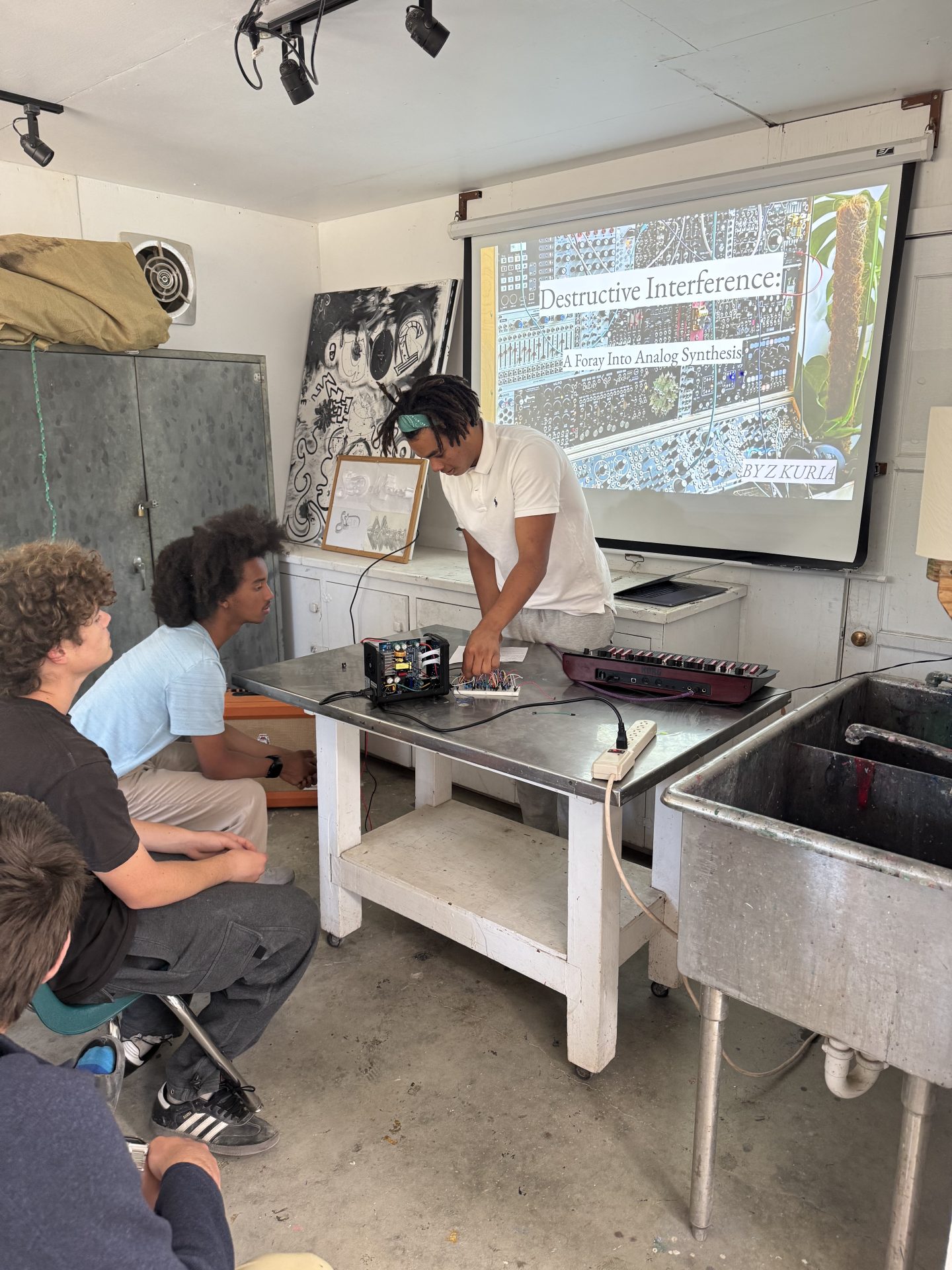
Z demos his synthesizer for the audience

Maybe. But I don’t think it would have unfolded the same way. At a larger school, this probably wouldn’t have stood out very much. Here, people were genuinely curious about it because Midland encourages unusual projects and individual passions. That made me want to keep going.
It gives you a lot more respect for the people who do this professionally. You can intellectually understand something, but actually building it forces you to confront all the complexity underneath it.
I think it made me more empathetic toward engineers, designers, manufacturers, anyone creating complicated systems. You realize how much invisible work exists behind the objects people use every day.
I don’t think people necessarily lose something. But I think there’s a huge amount to gain from approaching technology differently.
When you only consume technology, you give away a certain amount of agency and understanding. Building something yourself changes your relationship with the object completely. It stops feeling magical and starts feeling human.
Definitely. I did a huge amount of traditional academic research during this project. But then I’d actually start building something and suddenly realize I had no idea how to solve the real-world problems showing up in front of me.
That’s when you realize how different hands-on learning actually is. You can only learn so much from reading.
Honestly, just the work itself. I learned that good things are worth struggling for. And I also learned that making something real is very different from imagining it. There’s something meaningful about trying to create impact in the world instead of only thinking about ideas abstractly.
We’re not just brains in jars. At some point you have to actually make something, build something, test something, affect something outside yourself. Learning how to make an impact, even on a small scale, matters.
That’s something you can’t really understand until you try it.
–
Now, with graduation only days away, Z is preparing to head to UC Santa Cruz, where he plans to study biochemistry while continuing to explore music, sound, engineering, and health sciences on his own terms.
The synthesizer sitting on his desk is still unfinished in some ways. There are filters he still wants to build, circuits he still wants to solder permanently, and ideas he still wants to test. But perhaps that feels fitting.
For Z, the most important thing the project built may not have been the synthesizer itself, but the confidence to keep asking questions long after the assignment ended.
Written by Jasmine Fullman, Admissions Associate